Photo: AzmanJaka / E+ / Getty Images

Safety Culture

Monochrome photography, Black, Black-and-white, Pattern, Style, Line, White

Retired Safety Professionals

The Journeys of

Stories and advice on a meaningful life after full-time work

By Michael Saujani, CSP. CPCU

I

        had a friend who was a safety professional. When he retired, I attended his retirement party. It was a very happy moment. “Congratulations on your outstanding accomplishments and happy retirement,” his friends said. Less than a year later, his wife called me and told me tearfully that her husband had died.
    I went to his funeral, where his wife explained: “He was very happy just after his retirement. Then he had nothing meaningful to do and became easily irritated and depressed. He became a couch potato. He started to drink a little and then a lot. He put on some weight and then became sick and never recovered.”
    After learning about my friend’s unfortunate demise, I decided to do something. As safety professionals, our aim is to help people avoid injuries and illness. So, I decided to interview retired safety professionals in the Illinois area, ASSP Region V, to get insights on their journey to retirement and learn how to prevent similar injuries and illnesses in those who are retired, about to retire, or plan to retire in the future.

Demographics of Retired Safety Professionals
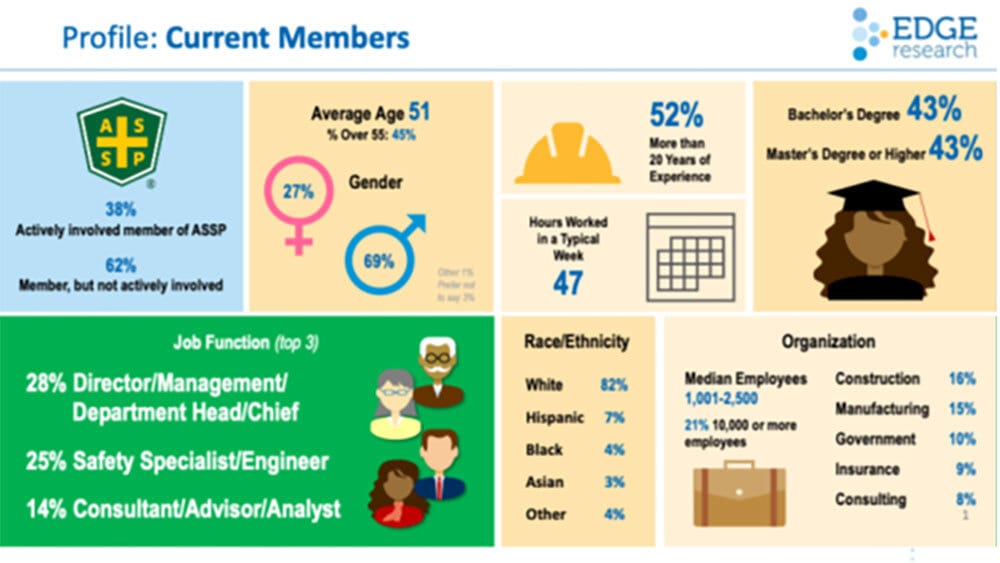
    For the year 2025, there are 36,114 safety professionals registered as members of the American Society of Safety Professionals (ASSP) worldwide. They work professionally in different capacities, including construction, manufacturing, government, insurance, and consulting as shown in the chart below. Over the last five years, an average of 1,077 hold emeritus (retired) membership, with a high of 1,085 and a low of 1,054.
    Per the Board of Certified Safety Professionals (BCSP) directory, there are currently 27,012 certified safety professionals of whom 1,449 are retired. Of these retired CSPs, fifty reside in Illinois, including nine females and forty-one males. I interviewed 10% of this population or five retired CSPs for this project. Four were male, including myself, and one was female. Three of the female retired safety professionals I reached out to for participation said they were busy. Only one woman agreed to participate after I pleaded to her that this might be my last article as an eighty-year-old retiree.

Insights from Retired Safety Professionals
    
Richard’s journey in safety started after he was involved in a motorcycle accident and was in a coma for almost six months. After recovering from the coma, he got a degree in education and started teaching defensive driving at local high schools and then at Liberty Mutual Insurance. He had stints with several insurance companies in important positions. He later became a construction specialist and expert witness in deep tunnel projects. Richard claims he retired two years ago, but at eighty years of age, he is still engaged in safety. He maintains his ASSP membership and CSP credentials and attends Northeastern Illinois (NEIL) chapter safety meetings. He says: “It is a good thing that I need to work as I do not have a good pension and haven’t saved enough in 401(k) or IRA retirement accounts. When I am not busy looking for a job as an expert witness or in construction consulting, I spend time in the pool, go for daily walks, play to earn points in the AARP Rewards program, and participate in volunteer activities.” His advice to retired safety professionals is: Stay healthy by exercising regularly and eating good food. Stay engaged. Be kind and helpful. Keep working as long as you physically can.
    Scot’s journey in safety started soon after graduating from the School of Architecture at the New York Institute of Technology, when he was recruited as a loss control representative in an insurance company. During the last forty-some years he has worked in various capacities at several large insurance companies, including as construction and property specialist at company headquarters. In recent years, he was moved to a field inspection role. He got bored and tired of doing field inspections and decided to retire as he had accumulated enough 401(k) savings and was already at a retirement age where he would get maximum Social Security benefits. After retiring, he created a routine of going to the gym and volunteering at a food bank and orphanages. Unfortunately, he suffered a back injury and had surgery, and then his life partner passed away, all of which made it difficult to get back to normal retired life. His advice to safety professionals who are planning their retirement is to find your inner self, discover what motivates you other than professional work, and explore your options. Develop a routine: walking, reading, watching TV shows. Go to your local senior center and participate in their activities, which generally include tai chi, bridge, yoga classes, etc.

    Pat’s journey started when he was eighteen and working as a volunteer fire fighter. After graduating from college with a degree in fire protection engineering, he was hired by CNA Insurance. He had an illustrious career there and at other large corporations, making a significant impact in safety. He wanted to continue making contributions but at seventy-seven years his body suggested he retire. Even after retirement, he has stayed active in his local ASSP chapter as president, treasurer, secretary, and other positions. He currently helps his homeowner’s association in risk management and insurance matters. He is blessed to have a loving, caring wife who always keeps him happy and away from the comfortable couch by doing something meaningful. His suggestion for retired safety professionals is to keep active: go fishing, do volunteer work at your local church or senior center, and offer your services through programming such as defensive driving courses.
    Following in her mother’s footsteps, Anita received a nursing degree and began her safety journey as a nurse at Northwestern Memorial Hospital. She eventually became an occupational nurse and then a safety manager/occupational nurse at Best Foods, a mayonnaise manufacturer. She later served as director of environmental safety at Sara Lee Corporation, a consumer-baked goods company. She has had an accomplished professional career. Anita decided to retire early since her children were grown and she was in good financial health. She met someone who wanted to travel the world with her. So, she retired, and she is very happy she did. Now as a 70-year-old retiree, she travels and helps take care of her five little grandchildren, whom she loves very much. They take up so much of her time that she has no time for anything else. She is very active in her church, where she helps the disabled and elderly. Her advice to new retirees: Maintain relationships and be active.
    My own journey started when I emigrated from Africa to America with an engineering degree. I found my first real job when a corporate vice president of American Mutual Insurance Company traveling from Boston stopped through Chicago and interviewed me at a hotel adjacent to O’Hare International Airport. Shaking his hand firmly, I introduced himself as a safety engineer, except that when I said it, it sounded like “safety genius.” That got his attention, he later confessed to me with a smile. This was during the era when the Occupational Safety and Health Act was passed and Martin Luther King, Jr.’s push for civil rights forced companies to recognize the need to hire minorities.
    I went on to become a senior loss control consultant and later safety supervisor at a large national insurance company. A large label-printing company I consulted with liked my skills and hired me as a corporate safety director to run its safety initiatives. When I turned 69, the company eased me out so they could hire a younger safety professional. After retirement, I attended classes in English literature and grammar at a nearby college to become proficient in English. I went on to become a newsletter editor and later president of the Northern Illinois chapter of ASSP. I was the winner of the NEIL chapter Safety Professional of the Year (SPY) Award and recipient of ASSP Region V SPY Award. I have written several articles that were published by Professional Safety Journal and a local magazine, South Barrington Life. I have written two books since retiring, a safety book and a novel. I have made several presentations at professional development conferences. I even helped my daughter, who is a robotic surgeon, when she complained of wrist strain. I completed an ergonomic evaluation of her workstation, published my findings, and presented them at a medical conference, which ultimately led to design improvements of the machine.
    I feel that I’ve had a great journey thanks to the ASSP and the culture of caring and helpfulness it has developed among its members. My advice to retirees is to follow your dreams, try activities you wanted to do but could not because of your previous family responsibilities, develop a routine of exercise and reading, stay engaged with safety professionals, neighbors, and friends, maintain mental acuity by playing bridge or jigsaw word puzzles, and join your high school or university alumni club as it will help you reconnect with old friends.

Once the excitement immediately following retirement wears off, life can become boring and filled with anxiety and fear.

Develop Your Retirement Action Plan
    Once the excitement immediately following retirement wears off, life can become boring and filled with anxiety and fear. You have nothing to do all day. You might be fearful of your finances, loneliness, poor health, suicidal thoughts, or even of dying. Your days go by as you schedule doctor or dentist appointments for pain and wellness and pharmacy visits to pick up prescriptions. But you can change this FEAR into a formidable force by following some guidance as recommended by your peer group.

FOLLOW – Follow your dreams
    • Follow your suppressed dreams and aspirations. Keep motivated. Be the writer you always wanted to be. Visit faraway places and cultures you saw on TV shows and movies. Take your kids and grandkids for a grand vacation.
   Cherish and maintain friendships with colleagues and acquaintances. Keep in touch with phone calls or texts.

ENGAGE – Stay active and fully engaged
    • Participate in the ASSP Board Communication Series, ASSP chapter meetings, and ASSP chapter committees.
    Read articles in Professional Safety Journal and listen to webinars using the information to help your friends and community.
    Be a presenter at conferences, local senior centers, or church functions on safety, fire protection, defensive driving, etc.
    Participate in or sponsor ASSP chapter programs and golf outings as a gesture of giving back to institutions that have supported you in your career.
    Engage regularly with chapter acquaintances, friends, family, and previous co-workers.
    Attend and participate in homeowners’ association meetings, senior center board meetings, and local church, temples, mosques or synagogue meetings.
    Teach students about safety at primary schools, middle schools, high schools, and universities based on your expertise, such as fire safety, defensive driving, fall protection, etc.
    Volunteer at food banks, Habitat for Humanity, and other non-profit organizations using your professional skills if required.

ACCESS – Be accessible as a coach and a mentor
    Be accessible to students, neighbors, church leaders, and others. Always be ready to consult and help using your safety professional expertise.
    Continue to utilize your union membership by joining a union alumni club.
    Join the alumni club of your high school or university and participate when they have meetings or events.
    Maintain a network of friends and colleagues who you can turn to when you need help.

ROUTINE – Maintain a routine
    Develop a daily routine and follow it.
    Maintain your mental acuity by renewing your ASSP membership and regularly reading Professional Safety Journal, BCSP News, and the National Safety Council newsletter.
    Maintain your regular routine, for example, by getting up on time, going to sleep on time, and going for a walk or to the gym every day.
    Maintain your mental acuity by regularly playing bridge and other brain teasers such as a daily crossword or participate in the AARP Rewards program.
    Assist your spouse in daily chores such as washing dishes, cleaning the house, doing laundry, and taking care of grandchildren.
    In conclusion, do not become a couch potato. Instead, strive to be healthy both physically and mentally. Do not Fear your retirement, be brave and fight the fear with F-E-A-R: Follow your dream; Engage actively with your safety professionals, neighbors, and friends; Access the resources available to you in your profession, local community, and churches; and maintain a Routine to keep mentally and physically healthy.

Michael Saujani, CSP, CPCU, ALCM. ARM is retired president of MKS Safety, LLC, that provided loss control consulting services to various clients in the Chicago metropolitan area. He has worked with national insurance companies in various capacities including Senior Loss Control Consultant and Supervisor. He was a corporate safety director for Fort Dearborn Company retiring in 2013. He holds a bachelor’s degree in mechanical engineering and graduated with first class with honors. He is a professional member of American Society of Safety Professionals (ASSP) and recipient of SPY (Safety Professional of the Year) awards. He has authored two books: How to Cultivate World-class Safety Culture and From Mapigi Village to America.

1. AARP Rewards Program: https://www.aarp.org/rewards/earn/#page=12
2. Bridge Base Online: https://www.bridgebaseonline.com
3. AARP: https://www.aarp.otg
4. Hanover Township, IL – Senior Center: https://www.hanover-township.org
5. Northern Illinois Food Bank: https://solvehungertoday.org
6. Painters District Council 30. Aurora, Illinois: pdc30.com
7. How to Cultivate a World-class Safety Culture: Actively Engaging Employees Using Five Pillars of Safety (2016): https://www.amazon.com/How-Cultivate-World-class-Safety-Culture/dp/1539123308/
8. From Mapigi Village to America (2024): https://www.amazon.com/Mapigi-Village-America-Michael-Saujani/dp/B0DHVCF5T5
9. “A World-Class Safety Culture: Applying the Five Pillars of Safety,” Professional Safety, February 2016: https://aeasseincludes.assp.org/professionalsafety/pastissues/061/02/F3_0216.pdf.
10. “Senior Management Commitment to Safety: A Critical Factor in Achieving Safety Results,” CPCU Society Insight, Summer 2015.
11. “Safety at Fort Dearborn Co.: Transforming from ‘Most Wanted’ to the Best in Class,” Professional Safety, March 2004: https://www.proquest.com/openview/cd0e562327c9ced6a8327f1a80d19e07/1?pq-origsite=gscholar&cbl=4726
12. “How to Ease Ergonomic Strains During Robot-assisted Surgeries,” ISE Magazine, October 2022: https://www.iise.org/isemagazine/details.aspx?id=53401.
13. “So You Want the Corner Safety Office?” Professional Safety, July 2018:https://www.jstor.org/stable/48690204
14. OLDER ADULT SAFETY Michael Saujani Professional Safety, February 2021: https://www.jstor.org/stable/48691023


April 2026

Azure, Line, Font, Text, Blue

VOL. 60  NO. 3